
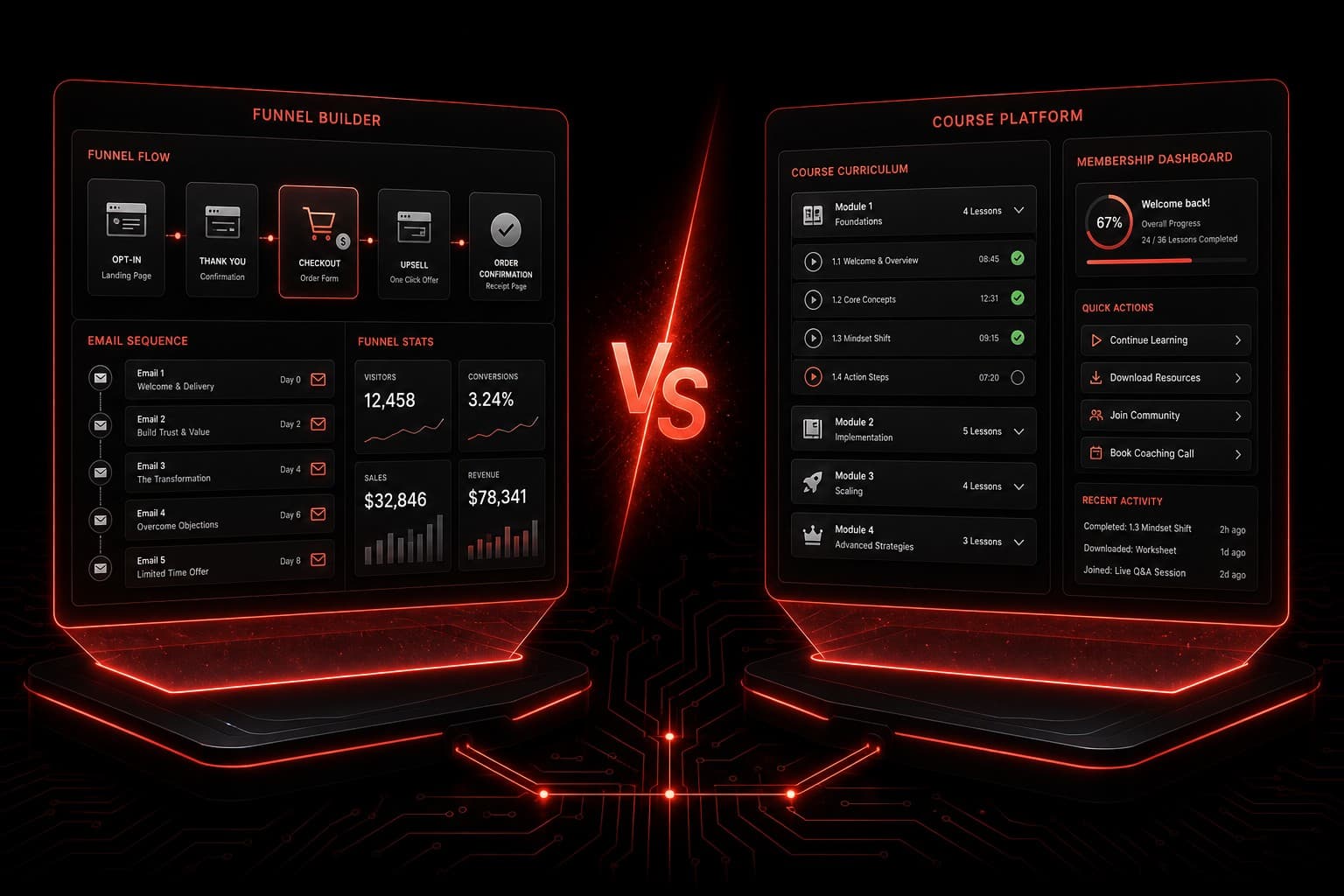
If you sell online courses, coaching programs, or memberships, you have probably narrowed your platform shortlist to two names: Kartra and Kajabi.
Both promise an all-in-one platform that replaces a half-dozen separate tools. Both handle course hosting, email marketing, landing pages, and payments. And both charge enough per month that you want to pick the right one the first time.
I have built funnels, email sequences, and membership areas inside both platforms. This comparison is based on that hands-on experience — not a feature matrix I pulled from a sales page.
Quick Summary
- Kartra wins on funnel building, checkout flexibility, and marketing automation depth
- Kajabi wins on course creation tools, user experience, and community features
- Kartra starts at $119/month; Kajabi starts at $149/month
- Choose Kartra if your business runs on funnels and email sequences
- Choose Kajabi if your primary product is courses and you want the cleanest learner experience
What Kartra and Kajabi Actually Do
Both are cloud-based platforms built for knowledge entrepreneurs — course creators, coaches, consultants, and info product sellers. They bundle tools that would otherwise require separate subscriptions.
Kartra launched in 2018 and leans heavily into marketing automation. It was built by the team behind WebinarJam and EverWebinar, so the DNA is direct response marketing.
Kajabi launched in 2010 and started as a pure course platform. It has expanded into email, pages, and community over the years, but the course experience remains the center of gravity.
If you want a deeper look at either platform individually, check the full Kartra review or the Kartra vs GoHighLevel comparison for a different angle.
Course Creation and Content Delivery
This is where Kajabi pulls ahead.
Kajabi's course builder is genuinely excellent. You get multiple content types (video, text, downloads, quizzes), drip scheduling, progress tracking, completion certificates, and a clean student dashboard that looks professional without custom design work.
Kartra has a membership and course area, but it feels like it was bolted on after the marketing engine was built — because it was. You can deliver content, gate it behind payment, and drip it over time. But the student experience is more utilitarian. The interface works, but it does not feel as polished as Kajabi's.
Community Features
Kajabi added a built-in community feature that works like a lightweight Circle or Skool alternative. Students can post, comment, and interact inside your Kajabi site without leaving the platform.
Kartra does not have native community. You would need to connect a third-party community tool, which adds complexity and cost.
Winner: Kajabi — the course builder and community features are meaningfully better.
Funnel Building and Landing Pages
This is where Kartra takes the lead.
Kartra's page and funnel builder is one of the most capable drag-and-drop builders on the market. You get behavioral triggers, exit-intent popups, countdown timers, A/B testing, and multi-step funnels with conditional logic. The template library is extensive, and the builder gives you granular control over layout without needing code.
Kajabi's page builder is functional but more limited. You work within pre-designed sections and have less flexibility on layout customization. It is faster to get a clean page live, but harder to build complex multi-step funnels with conditional branching.
If your business model depends on webinar funnels, tripwire sequences, or multi-step launch funnels, Kartra gives you significantly more firepower.
Winner: Kartra — deeper funnel logic, better A/B testing, more design flexibility.
Email Marketing and Automation
Both platforms include email marketing. The difference is depth.
Kartra's automation builder uses a visual flowchart-style interface where you can branch based on behavior: page visits, video watch percentage, email opens, link clicks, tag assignments, purchase history, and more. You can build genuinely complex sequences that rival dedicated email platforms like ActiveCampaign.
Kajabi's email tool handles broadcasts and basic automations well. You can send emails based on purchases, form submissions, and a few behavioral triggers. But the automation logic is simpler — fewer branching conditions, fewer trigger types, less granular segmentation.
For a solo course creator sending weekly newsletters and a welcome sequence, Kajabi is perfectly fine. For a business that runs multi-step nurture campaigns with behavioral branching, Kartra is the stronger choice.
Winner: Kartra — more automation depth, more trigger types, more flexibility.
Checkout and Payments
Both platforms process payments through Stripe (and Kartra also supports PayPal natively).
Kartra's checkout is more feature-rich. You get order bumps, one-click upsells, downsells, payment plans, trial periods, coupon codes, and built-in affiliate tracking on every checkout. The checkout pages themselves are customizable within the page builder.
Kajabi handles payments cleanly with support for one-time payments, subscriptions, payment plans, and free trials. It recently added order bumps. But it lacks the full upsell/downsell funnel flow that Kartra offers out of the box.
If you are running a simple course checkout, both work fine. If you are optimizing average order value with upsell sequences, Kartra is built for that.
Winner: Kartra — more checkout options, native upsells and downsells.
Pricing Comparison (2026)
Here is the current pricing side by side:
| Feature | Kartra Starter | Kajabi Basic |
|---|---|---|
| Monthly Price | $119/mo | $149/mo |
| Contacts | 2,500 | 10,000 |
| Products | Unlimited | 3 |
| Email Sends | 15,000/mo | Unlimited |
| Custom Domains | 1 | 1 |
| Admin Users | 1 | 1 |
| Landing Pages | Unlimited | Unlimited |
| Funnels | Unlimited | Unlimited |
The pricing tells you a lot about the target audience. Kartra gives you unlimited products but limits contacts. Kajabi limits products but gives you more contacts.
At the entry level, Kartra is $30/month cheaper. But if you only sell one or two courses and have a large email list, Kajabi's higher contact limit might save you from upgrading sooner.
Both platforms offer annual discounts (roughly 20 percent off) and both have higher tiers for growing businesses.
For a broader look at how these platforms compare to CRM-focused tools, the GoHighLevel pricing breakdown shows a very different value proposition.
Ease of Use
Kajabi wins on simplicity. The interface is clean, modern, and intuitive. Most creators can build a course, connect a payment, and launch a basic funnel within a day. The learning curve is gentle.
Kartra has more features, which means more complexity. The dashboard can feel overwhelming at first. The page builder is powerful but has a steeper learning curve. Once you learn it, you move fast — but the first week or two requires more patience.
If you are not particularly technical and want to focus on creating content rather than configuring marketing systems, Kajabi will feel more comfortable.
Winner: Kajabi — cleaner interface, faster time to first launch.
Integrations and Ecosystem
Neither platform is as open as a dedicated automation tool like Make.com or Zapier, but both connect to the major services.
Kajabi integrates natively with Stripe, Google Analytics, Facebook Pixel, and a handful of email tools. It has a Zapier integration for connecting to other apps, but native integrations are limited.
Kartra has more built-in integrations: payment gateways (Stripe, PayPal, Authorize.net, Braintree), email services, membership platforms, and calendaring tools. It also has its own API and a Zapier connection.
For businesses that need deep workflow automation beyond what either platform offers natively, connecting to an external automation layer like n8n or Make.com is the practical path. The business automation guide covers how to think about that stack.
Who Should Choose Kartra
Kartra is the better fit if:
- Your business runs on funnels — webinar funnels, launch sequences, tripwire offers
- You need complex email automation with behavioral branching
- You want built-in affiliate management
- You sell multiple products and need flexible checkout flows with upsells
- You are comfortable with a steeper learning curve in exchange for more control
Try Kartra free for 30 days and build your first funnel to see if the workflow fits.
Disclosure: The Kartra link above is an affiliate link. If you purchase through it, I may earn a commission at no extra cost to you.
Who Should Choose Kajabi
Kajabi is the better fit if:
- Your primary product is online courses or coaching programs
- You want the best-in-class student experience out of the box
- You need built-in community features
- You prefer a simple, clean interface over deep customization
- You have a smaller product catalog (one to three core offers)
My Honest Take
I have recommended both platforms to different clients based on their situations. The honest answer is that neither is universally "better" — they optimize for different things.
If I am talking to someone whose business is fundamentally about teaching — courses, memberships, coaching — and they want the cleanest possible experience for their students, I point them to Kajabi.
If I am talking to someone whose business is built on marketing funnels, email sequences, and maximizing revenue per customer, I point them to Kartra. The automation engine and checkout flexibility are genuinely powerful.
And if you are an agency or service business that needs a full CRM with pipelines, SMS, and client management — neither of these is the right tool. That is a different category entirely, which is why the Kartra vs GoHighLevel comparison exists.
Frequently Asked Questions
Can I migrate from Kajabi to Kartra or vice versa?
Yes, but it is manual work. Neither platform offers a one-click migration tool. You would need to export your contacts (CSV), rebuild your pages and funnels in the new platform, and re-upload your course content. Email sequences need to be recreated from scratch. Budget a few days for the migration depending on how much content you have.
Does Kajabi or Kartra handle SEO better?
Both are adequate for basic SEO — you can set page titles, meta descriptions, and URL slugs. Neither is a WordPress-level SEO platform. Kajabi has slightly cleaner default URL structures. For serious SEO, you would want a dedicated content site regardless of which platform you use for course delivery.
Can I use Kartra or Kajabi with GoHighLevel?
Yes. Many businesses use GoHighLevel as their CRM and client communication hub while using Kartra or Kajabi specifically for course delivery. You can connect them via Zapier or webhooks to sync contacts and trigger automations across platforms. The GoHighLevel CRM tutorial walks through the CRM side of that setup.
Which platform has better customer support?
Both offer email and chat support. Kajabi is generally faster on response times and has a more active user community. Kartra's support is competent but can be slower during peak periods. Both have extensive knowledge bases and video tutorials.
The Bottom Line
Pick the platform that matches how you make money. Course-first businesses thrive on Kajabi. Funnel-first businesses thrive on Kartra. Do not overthink it — pick one, build your first offer, and start selling. You can always migrate later if your business model shifts.
If you are not sure which direction fits your business, book a free strategy session and I will walk you through the decision based on your specific situation.