
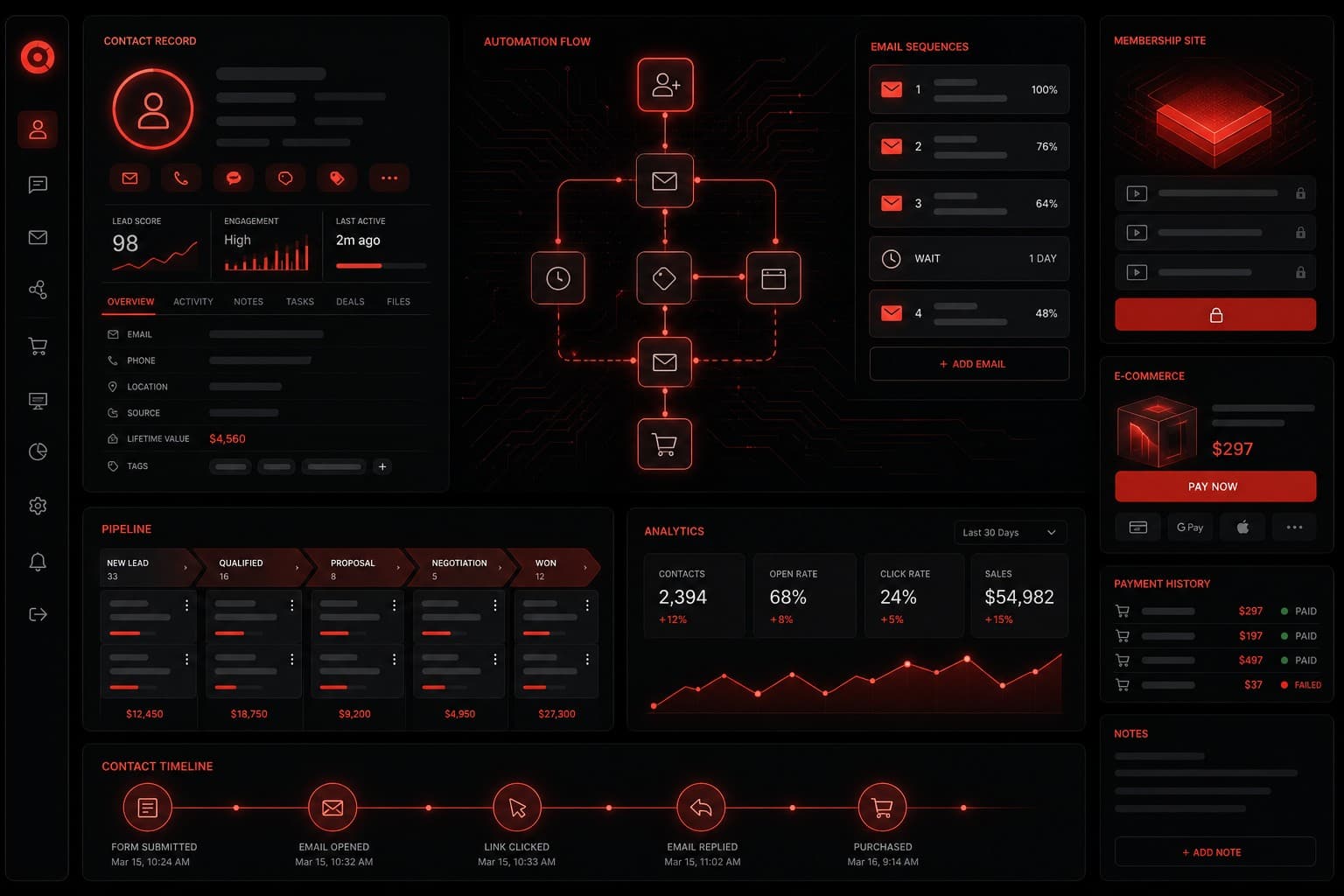
Ontraport has been around since 2006 — long before most of today's all-in-one platforms even existed. Originally called OfficeAutoPilot, it quietly built a reputation as the serious marketer's CRM. While flashier tools grabbed headlines, Ontraport stayed focused on what actually moves revenue: deep automation, real contact management, and built-in tools for membership sites and e-commerce.
After spending time inside the platform and comparing it against tools I work with every day, here is my honest take on where Ontraport shines, where it falls short, and who it is really built for in 2026.
Quick Summary
- Ontraport is a CRM + marketing automation platform built for info-product creators, coaches, and mid-market marketers
- Visual campaign builder handles complex multi-step automations with branching logic
- Built-in membership sites, payment processing, and landing pages reduce the need for third-party tools
- Pricing starts at $24/month but most businesses will need the $83/month Plus plan
- Best suited for marketers who need deep automation — not the simplest option for beginners
What Is Ontraport?
Ontraport is an all-in-one business automation platform that combines CRM, email marketing, landing pages, e-commerce, membership sites, and visual campaign automation in a single dashboard. It targets small-to-mid-size businesses — especially coaches, course creators, consultants, and digital marketers who sell information products or services online.
Unlike lightweight email tools that bolt on CRM features as an afterthought, Ontraport was built from the ground up as a contact-centric system. Every interaction a lead has with your business — email opens, page visits, purchases, form submissions — feeds into a single contact record that drives your automation logic.
If you have ever used tools like GoHighLevel or Kartra, Ontraport sits in a similar category. The difference is in the depth of its automation engine and its laser focus on the info-product and coaching market.
Ontraport's Core Features
CRM and Contact Management
The CRM is the backbone of Ontraport. Every contact stores a complete timeline of their interactions — emails received, pages visited, purchases made, tags applied, and automation sequences triggered. You can create custom fields, segment contacts by virtually any criteria, and build lead scoring models that automatically prioritize your hottest prospects.
The contact record view is information-dense. It shows you everything about a person in one place, which is powerful but can feel overwhelming if you are coming from a simpler tool. For data-driven marketers who want to see the full picture before making a call, this level of detail is exactly what you need.
Visual Campaign Builder
This is where Ontraport genuinely differentiates itself. The visual campaign builder lets you map out entire marketing campaigns as flowcharts — triggers, conditions, delays, actions, and branches all displayed as connected nodes on a canvas.
You can build sequences like: someone opts in → wait 2 days → send email → if they click, send offer → if they buy, enroll in membership → if they don't buy, wait 3 days → send follow-up with different angle. The branching logic handles virtually any "if/then" scenario you can think of.
In my experience building automation workflows across platforms like n8n and Make.com, Ontraport's campaign builder is one of the more intuitive visual interfaces I have seen for marketing-specific sequences. It does not require code, and the drag-and-drop canvas makes it easy to see the entire customer journey at a glance.
Email Marketing
Ontraport offers both broadcast emails (one-time sends) and automated email sequences triggered by contact behavior. The email editor supports drag-and-drop design with responsive templates, and you can personalize content using merge fields from any contact data point.
Deliverability has historically been a strength for Ontraport. They maintain their own sending infrastructure and offer dedicated IP addresses on higher plans. For marketers sending high-volume campaigns — especially in the info-product space where aggressive email cadences are common — deliverability can make or break your results.
Key email features include:
- A/B testing on subject lines and content
- Send time optimization
- Engagement-based segmentation
- Automatic suppression of unengaged contacts
- UTM parameter tracking for campaign attribution
Landing Pages and Forms
Ontraport includes a built-in landing page builder with a library of templates. The editor is functional — you can build opt-in pages, sales pages, and thank-you pages without leaving the platform. It supports custom domains, A/B testing, and mobile-responsive designs.
Is it as polished as a dedicated landing page tool? No. If you are used to high-end page builders, Ontraport's pages will feel adequate rather than exceptional. But for most use cases — especially simple opt-in and webinar registration pages — it gets the job done without adding another monthly subscription.
Membership Sites
One feature that sets Ontraport apart from many competitors is native membership site functionality. You can create gated content areas, drip-feed course modules, manage access levels, and process payments — all within Ontraport.
This is a major draw for course creators and coaches. Instead of paying for Kajabi, Teachable, or Thinkific alongside your CRM, you can consolidate everything into one platform. The membership experience is not as visually polished as dedicated course platforms, but it handles the core functionality: content gating, drip schedules, user management, and payment integration.
E-Commerce and Payments
Ontraport processes payments natively through integrations with Stripe, PayPal, and Authorize.net. You can sell one-time products, create subscription plans, build order forms, and manage upsells and order bumps — all tied directly to your CRM automation.
The purchase data feeds directly into contact records, so you can trigger post-purchase sequences, segment buyers by product, calculate customer lifetime value, and build re-engagement campaigns based on purchase history. For marketers running sophisticated product funnels, having payment and CRM data in the same system eliminates the duct-tape integrations that cause data leaks.
Ontraport Pricing in 2026
Ontraport offers four pricing tiers:
| Plan | Monthly Price | Contacts | Users |
|---|---|---|---|
| Basic | $24/month | 500 | 1 |
| Plus | $83/month | 1,000 | 2 |
| Pro | $124/month | 2,000 | 3 |
| Enterprise | Custom | 20,000+ | 5+ |
A few things to note about pricing. The Basic plan at $24/month looks attractive, but it excludes several features that most businesses will need — including the visual campaign builder, e-commerce, and membership sites. In practice, most marketers will land on the Plus or Pro plan.
Compared to GoHighLevel's $97/month unlimited plan or Kartra's starter tier, Ontraport's mid-tier pricing is competitive. But the value equation depends on what you actually use. If you need membership sites, deep CRM, and visual automation — Ontraport delivers a lot of value per dollar. If you mainly need a CRM with basic email, you might be overpaying for features you won't touch.
Contact limits also matter. Ontraport charges based on contact count, so as your list grows, your costs scale accordingly. This is standard in the industry but worth factoring into your long-term budget.
What Ontraport Does Well
Automation Depth
The visual campaign builder is Ontraport's marquee feature for good reason. It handles complex, multi-branch automations that would require workarounds or third-party tools on simpler platforms. If your business runs on sophisticated drip sequences, behavioral triggers, and conditional logic, Ontraport's engine is built for you.
All-in-One Consolidation
Having CRM, email, landing pages, membership sites, payments, and automation in one platform genuinely reduces complexity. You avoid the Zapier tax — the ongoing cost and fragility of connecting five or six SaaS tools together. Everything shares the same contact record, which means your data stays clean and your automations stay reliable.
Reporting and Analytics
Ontraport's reporting goes deeper than most competitors in this tier. You can track revenue attribution by campaign, measure email performance over time, analyze funnel conversion rates, and see exactly which automations are driving results. The ROI tracking is genuinely useful for marketers who need to justify their spend.
Established Platform Stability
With nearly 20 years in the market, Ontraport is not going anywhere. The platform is mature, regularly updated, and has a track record of uptime reliability. If you are building a business on top of your tech stack, platform stability matters more than feature lists.
Where Ontraport Falls Short
Learning Curve
Ontraport is powerful, but it is not simple. The interface has improved significantly over the years, but there is still a learning curve — especially for the campaign builder and CRM customization. New users who come from drag-and-drop-simple tools will need to invest time getting comfortable.
Design Limitations
The landing page and email builders are functional but not best-in-class from a design perspective. If visual design quality is a top priority, you may find yourself wanting to use dedicated tools for pages and templates, which somewhat undermines the all-in-one value proposition.
Agency Features
While Ontraport works well for individual businesses and small teams, it lacks the agency-centric features that platforms like GoHighLevel offer. There is no white-label option, no client sub-accounts, and no reseller model. If you run an agency managing multiple client accounts, this is a significant gap.
Smaller Ecosystem
Compared to HubSpot or Salesforce, Ontraport's integration marketplace and third-party ecosystem is smaller. You can connect it to common tools via Zapier or API, but native integrations are more limited. For businesses with complex tech stacks that require deep native connections, this can be a friction point.
Ontraport vs the Competition
How does Ontraport stack up against the platforms it is most often compared to?
Ontraport vs GoHighLevel: GoHighLevel wins for agencies with its white-label SaaS mode, sub-accounts, and broader feature set including SMS and voice. Ontraport wins for solo marketers and course creators who need deeper automation logic and native membership sites. If you are evaluating GHL, check out my full GoHighLevel review.
Ontraport vs ActiveCampaign: ActiveCampaign offers a more modern UI and stronger email-first experience. Ontraport offers more built-in features (membership, payments, landing pages) at a comparable price. ActiveCampaign is better for email-centric businesses; Ontraport is better for full-funnel marketers.
Ontraport vs Kartra: Both target info-product creators and course sellers. Kartra focuses more on funnel building and has a more polished page builder. Ontraport has a stronger CRM and deeper automation logic. The choice often comes down to whether you prioritize funnel aesthetics (Kartra) or automation sophistication (Ontraport).
Who Should Use Ontraport?
Ontraport is the right fit if you:
- Sell courses, coaching, or information products and need membership + CRM + automation in one platform
- Run complex marketing funnels with multi-step sequences, conditional branches, and behavioral triggers
- Want all-in-one consolidation without stitching together five separate tools
- Need strong reporting to track revenue attribution by campaign and source
- Are a data-driven marketer who values deep contact records and lead scoring over simple UI
Ontraport is probably not the right fit if you:
- Run a marketing agency and need white-label or sub-account management
- Want the simplest possible tool with minimal learning curve
- Primarily need a CRM without heavy automation or marketing features
- Are on a tight startup budget and only have a small contact list
Frequently Asked Questions
Is Ontraport good for beginners?
Ontraport has a steeper learning curve than tools like Mailchimp or ConvertKit. If you are brand new to marketing automation, expect to spend a few weeks getting comfortable with the platform. Their training resources and support help, but Ontraport rewards marketers who invest time in learning it properly.
Can Ontraport replace my course platform?
For basic to intermediate course delivery — yes. Ontraport's membership sites handle content gating, drip schedules, and payment processing. However, if you need advanced course features like quizzes, completion certificates, or community features, a dedicated platform like Kajabi or Thinkific may be a better fit.
Does Ontraport integrate with other tools?
Ontraport offers native integrations with popular tools including Stripe, PayPal, WordPress, Zoom, and Facebook Ads. For everything else, you can use their API or connect through Zapier. The integration ecosystem is smaller than HubSpot's but covers most common use cases.
How does Ontraport's deliverability compare?
Ontraport maintains its own email sending infrastructure and has historically strong deliverability rates. They offer dedicated IP addresses on higher plans, list hygiene tools, and engagement-based suppression — all of which contribute to keeping your emails out of spam folders.
Final Verdict
Ontraport is not the flashiest platform on the market, and it is not trying to be. It is a serious automation and CRM tool built for marketers who have outgrown basic email platforms and need real power under the hood.
If you sell information products, run complex funnels, or need membership site functionality alongside your CRM, Ontraport delivers genuine value. The visual campaign builder alone justifies the platform for automation-heavy businesses. The all-in-one consolidation eliminates integration headaches and keeps your data clean.
The trade-offs are real — the learning curve is steeper, the design tools are not best-in-class, and the agency features are limited. But for its target audience of solo marketers, coaches, and small teams running sophisticated campaigns, Ontraport remains one of the most capable platforms in 2026.
Ready to try Ontraport? Start your free trial with Ontraport and see how the automation engine compares to what you are using today.
Stephen Gardner is an AI automation specialist and CEO of Automation Warrior. With 20+ years in digital marketing — including 7 years on Google's Search team — he helps businesses replace manual work with intelligent automation systems. For a free strategy session on choosing the right platform for your business, book a call at automationwarrior.ai.