
Go High Level and HubSpot are both in the "marketing + CRM" category. That's about where the similarities end.
HubSpot built its reputation as the enterprise CRM — the polished, expansive platform that scales with a company from startup to IPO. Go High Level was built from the ground up for marketing agencies, with a fundamentally different economic model and a different set of priorities.
If you're an agency owner, a local business, or a small team trying to decide between these two, here's the real breakdown — not the marketing copy, but the actual trade-offs.
The Core Difference
Before we get into features and pricing: GHL is built for agencies. HubSpot is built for companies.
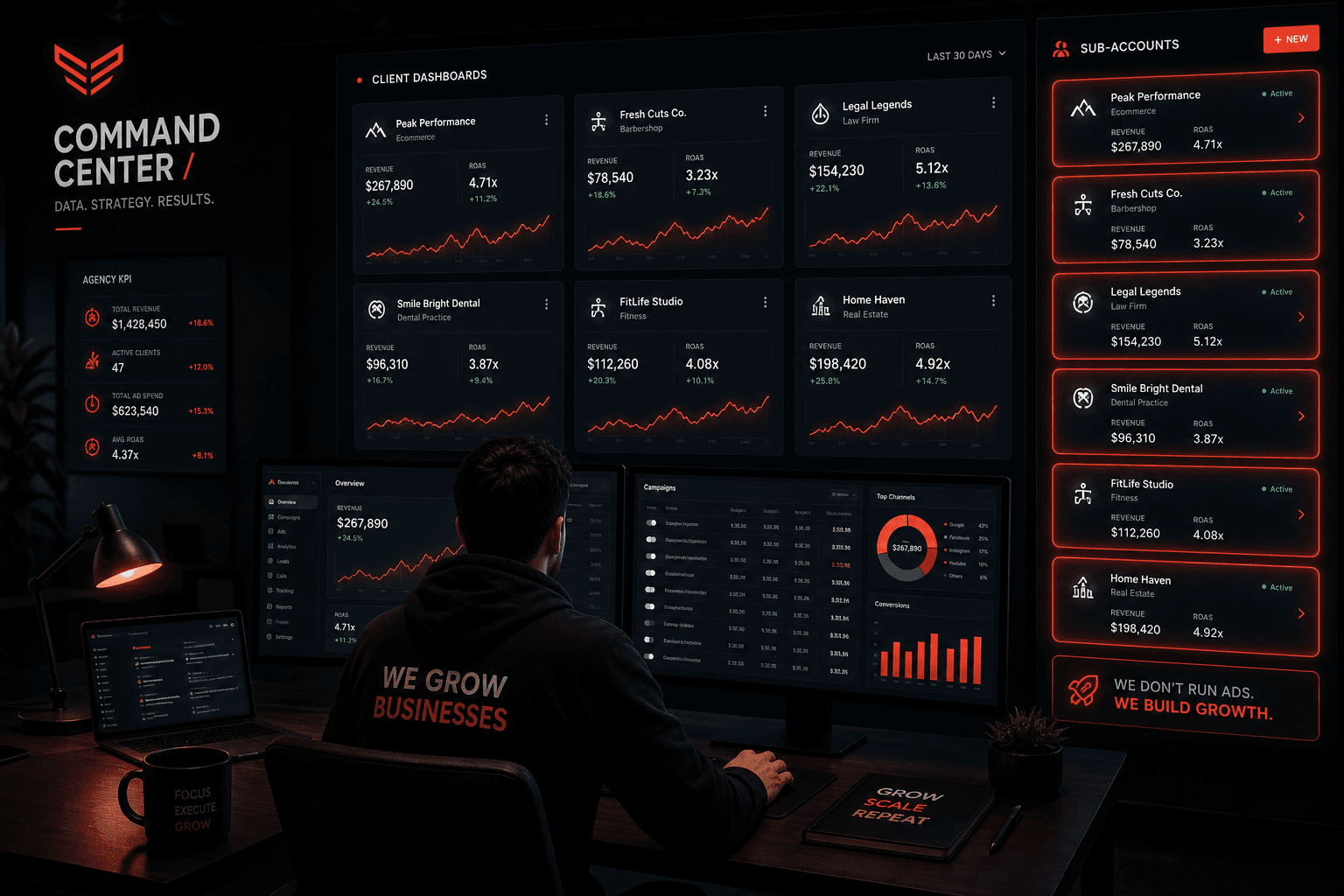
GHL's entire model is designed around an agency running marketing for multiple clients. The sub-account structure, the white-labeling, the SaaS reselling — all of it assumes you're managing marketing on behalf of others, not just for yourself.
HubSpot's model assumes you're one company growing. It scales beautifully for that use case. It does not have a sub-account model, and it's not designed to be resold.
Keep that frame in mind as we go through the comparison.
Pricing: The Real Story
This is where the comparison gets dramatic.
HubSpot Pricing
HubSpot's pricing has a reputation for looking reasonable and then expanding fast:
- Free CRM: Genuinely free — good for basic contact management and visibility
- Starter: Starts around $15–$20/seat/month — limited automation, basic marketing tools
- Professional: $800–$890/month — this is where most meaningful marketing automation kicks in
- Enterprise: $3,600+/month — full feature suite, custom reporting, SSO, and more
The "starts at $20/month" framing is technically accurate but misleading. If you want actual marketing automation (multi-step workflows, lead scoring, A/B testing, custom reporting), you're looking at Professional tier at minimum — which starts at $800/month for Marketing Hub. And that's per business, not unlimited clients.
Go High Level Pricing
- Starter: $97/month — full features for one account/business
- Unlimited: $297/month — unlimited sub-accounts (run any number of clients)
- SaaS Pro: $497/month — white-label + ability to resell GHL as your own platform
For an agency perspective, this is the pivotal comparison: HubSpot at $800+/month per client vs GHL at $297/month for unlimited clients.
If you're managing 10 clients on HubSpot at the Professional tier, you're looking at $8,000+/month in platform fees. The same 10 clients on GHL Unlimited: $297/month.
The economics are stark, and they're the primary reason agencies have been migrating to GHL in large numbers.
Pricing Comparison Table
| Go High Level | HubSpot | |
|---|---|---|
| Starting price | $97/month | Free (limited) |
| Meaningful automation tier | $97/month | ~$800/month |
| Multi-client/agency | $297/month unlimited | $800+/month per client |
| White-label/rebrand | $497/month | Not available |
| Per-seat model | No | Yes |
Feature Comparison
CRM Capabilities
HubSpot wins on CRM sophistication. Contact timelines, deal management, task management, advanced reporting, and native integrations with enterprise sales tools are best-in-class. If you have a complex B2B sales process with multiple team members, HubSpot's CRM depth is hard to match.
GHL's CRM covers the fundamentals well — contact management, pipelines, tags, custom fields — but it's designed for simpler sales processes, not enterprise deal management.
Marketing Automation
Both platforms have strong automation builders, but they serve different use cases.
HubSpot's automation is tightly integrated with its CRM, contact records, and deal stages. Enrollment logic, branching, A/B testing, and re-enrollment are all well-designed. It's a mature system with excellent reporting on automation performance.
GHL's automation covers more channels (email + SMS + voice + social messaging) and is more purpose-built for local business marketing workflows. The breadth of channels GHL covers in a single automation is genuinely impressive — and something HubSpot can't match without expensive add-ons.
Verdict: HubSpot for B2B email/CRM automation. GHL for local business omnichannel follow-up.
Email Marketing
HubSpot has excellent email tooling — a polished editor, solid deliverability, strong A/B testing, and deep segmentation using CRM data.
GHL has solid email that gets the job done. The template builder is less polished, but deliverability is good when properly configured, and the native integration with SMS and voice makes it more useful for certain campaign types.
Verdict: HubSpot edges GHL on email sophistication.
SMS and Omnichannel Messaging
GHL wins here with no contest. SMS is a first-class citizen in GHL — you can trigger SMS from any workflow event, run multi-step SMS sequences, and include two-way SMS conversations in your pipelines. HubSpot doesn't have native SMS (you need a Salesmsg or Aircall integration).
GHL also supports Facebook Messenger, Instagram DMs, Google Business Profile messaging, and voicemail drops in automations. HubSpot's omnichannel coverage requires third-party integrations and Enterprise-tier features.
For local businesses where SMS response rates are dramatically higher than email, this is a significant GHL advantage.
Funnel and Landing Page Builder
GHL has a built-in funnel and page builder. It's functional — not as polished as ClickFunnels, but adequate for campaign pages and lead capture. No extra cost.
HubSpot has landing page tools at the Professional tier and above. The pages are clean and well-integrated with the CRM, but again, this is an $800/month feature.
Appointment Scheduling
GHL has a full-featured calendar and booking system included. It rivals Calendly for core functionality and integrates natively with GHL automations — meaning you can trigger follow-up sequences based on booking events without any additional tools.
HubSpot has a meetings tool that works, but the deep automation integration requires more configuration and the Professional tier.
Reputation Management
GHL has built-in reputation management — automated review request campaigns via SMS or email, plus monitoring of Google reviews from inside the platform. This is a genuine differentiator for local businesses where review volume drives inbound traffic.
HubSpot doesn't have native reputation management tools. This requires third-party integrations.
Reporting and Analytics
HubSpot wins significantly. The reporting suite is excellent — custom dashboards, attribution reporting, funnel analytics, revenue reporting tied to deals. This is enterprise-grade reporting.
GHL has basic reporting that covers most needs for local business marketing, but it's not in the same league for complex analytics requirements.
Integrations
HubSpot wins on native integration depth. HubSpot has hundreds of native integrations with enterprise software — Salesforce, SAP, NetSuite, etc. — and a mature API.
GHL integrates well with common tools but has a narrower native integration library. Zapier and webhooks fill in the gaps, but it's an extra layer.
White-Labeling: GHL's Killer Feature
GHL's SaaS Pro tier allows you to completely white-label the platform — your brand, your domain, your pricing. Agencies use this to offer "Agency Marketing Suite" or "Practice Management Software" to clients at $97–$297/month per client, generating significant recurring revenue while the underlying infrastructure costs $497/month regardless of how many clients you have.
HubSpot has no white-label option. This entire business model — reselling a branded SaaS platform — is only possible with GHL (or a handful of competitors).
Head-to-Head Verdict
| Use Case | Winner |
|---|---|
| Marketing agencies with multiple clients | Go High Level |
| Local service businesses (plumbers, dentists, realtors) | Go High Level |
| Coaches and consultants | Go High Level |
| B2B SaaS companies | HubSpot |
| Enterprise sales teams | HubSpot |
| Complex CRM requirements | HubSpot |
| Tight budget, need real automation | Go High Level |
| Advanced reporting requirements | HubSpot |
My Take
For agencies and local businesses, Go High Level is the better choice — and it's not particularly close when you factor in the pricing. The Unlimited plan at $297/month giving you unlimited client accounts is simply better economics than paying HubSpot Professional pricing per client.
HubSpot is a serious platform and deserves its reputation for the use case it's designed for: B2B companies with sales teams, complex CRM requirements, and the budget to match. At those price points, HubSpot delivers.
But if you're running a marketing agency, or you're a local business looking for an all-in-one marketing and CRM system, Go High Level delivers more of what you actually need at a fraction of the cost.
Start your Go High Level free trial →
Read the full Go High Level Review for a deeper look at GHL's individual features and pricing tiers.